The correct answer is:
B) Delavirdine
The Lineweaver-Burk plot can be used to visualize the type of inhibition that a drug exerts on an enzyme. Understanding how an enzyme's V and Km are represented in the plot is essential for answering these types of questions on the exam.
V is the velocity, or the rate at which an enzyme works on its substrate; Vmax is the enzyme's maximum rate. On the Lineweaver-Burk plot, the y-axis is 1/V, or the inverse of the velocity. The y-intercept (where the line crosses the y-axis) is 1/Vmax. Thus, the steeper the slope of the line, the higher the y-intercept, the larger the value of 1/Vmax, and the smaller the enzyme's velocity Vmax.
Km represents the inverse of an enzyme's affinity for a substrate S (so an increasing Kmindicates a decreasing affinity for substrate). On the Lineweaver-Burk plot, the x-axis is 1/[S], or the inverse concentration of the substrate. The x-intercept (where the line crosses the x-axis) is 1/Km. Thus, as the line shifts to the right, the x-intercept approaches 0, Kmincreases, and the enzyme's affinity for substrate decreases.
The two most common types of inhibition are competitive inhibition and noncompetitive inhibition.
A competitive inhibitor structurally looks like the enzyme's normal substrate and will compete with the substrate for the enzyme's active site. A competitive inhibitor therefore lowers the enzyme's affinity for the substrate, increasing Km. There is no effect on Vmax. On the Lineweaver-Burk plot, since only Km increases, the x-intercept approaches 0 but the y-intercept (1/Vmax) remains unchanged.
A noncompetitive inhibitor will inhibit the enzyme at a site that is different than the active site, lowering the enzyme's Vmax. There is no effect on Km. On the Lineweaver-Burk plot, since only Vmax decreases, the y-intercept (1/Vmax) increases but the x-intercept (-1/Km) remains unchanged.
In this question, the red line in the plot demonstrates noncompetitive inhibition: the x-intercept (-1/Km) is unchanged, and the y-intercept (1/Vmax) has increased. Delavirdine is a non-nucleoside reverse transcriptase inhibitor (NNRTI), which binds to a site that differs from the active site of HIV reverse transcriptase and noncompetitively inhibits the enzyme.
Answer choice A: Darunavir, is incorrect. Darunavir inhibit HIV protease and does not inhibit reverse transcriptase.
Answer choice C: Didanosine, is incorrect. Didanosine is a nucleoside reverse transcriptase inhibitor (NRTI) and resembles the normal nucleoside substrates of HIV reverse transcriptase, thereby competitively inhibiting the enzyme. The Lineweaver-Burk plot in the question displays noncompetitive inhibition, not competitive inhibition.
Answer choice D: Dolutegravir, is incorrect. Dolutegravir inhibits HIV integrase and does not inhibit reverse transcriptase.
Answer choice E: Zidovudine, is incorrect. Zidovudine is a nucleoside reverse transcriptase inhibitor (NRTI) and resembles the normal nucleoside substrates of HIV reverse transcriptase, thereby competitively inhibiting the enzyme. The Lineweaver-Burk plot in the question displayed noncompetitive inhibition, not competitive inhibition.
Key Learning Point
On a Lineweaver-Burk plot, competitive inhibition is marked by a rightward-shift (x-intercept approaches 0, y-intercept is unchanged), whereas noncompetitive inhibition is marked by an increase in slope (y-intercept increases, x-intercept is unchanged). Non-nucleoside reverse transcriptase inhibitors (NRTIs) such as delavirdine inhibit HIV reverse transcriptase noncompetitively.

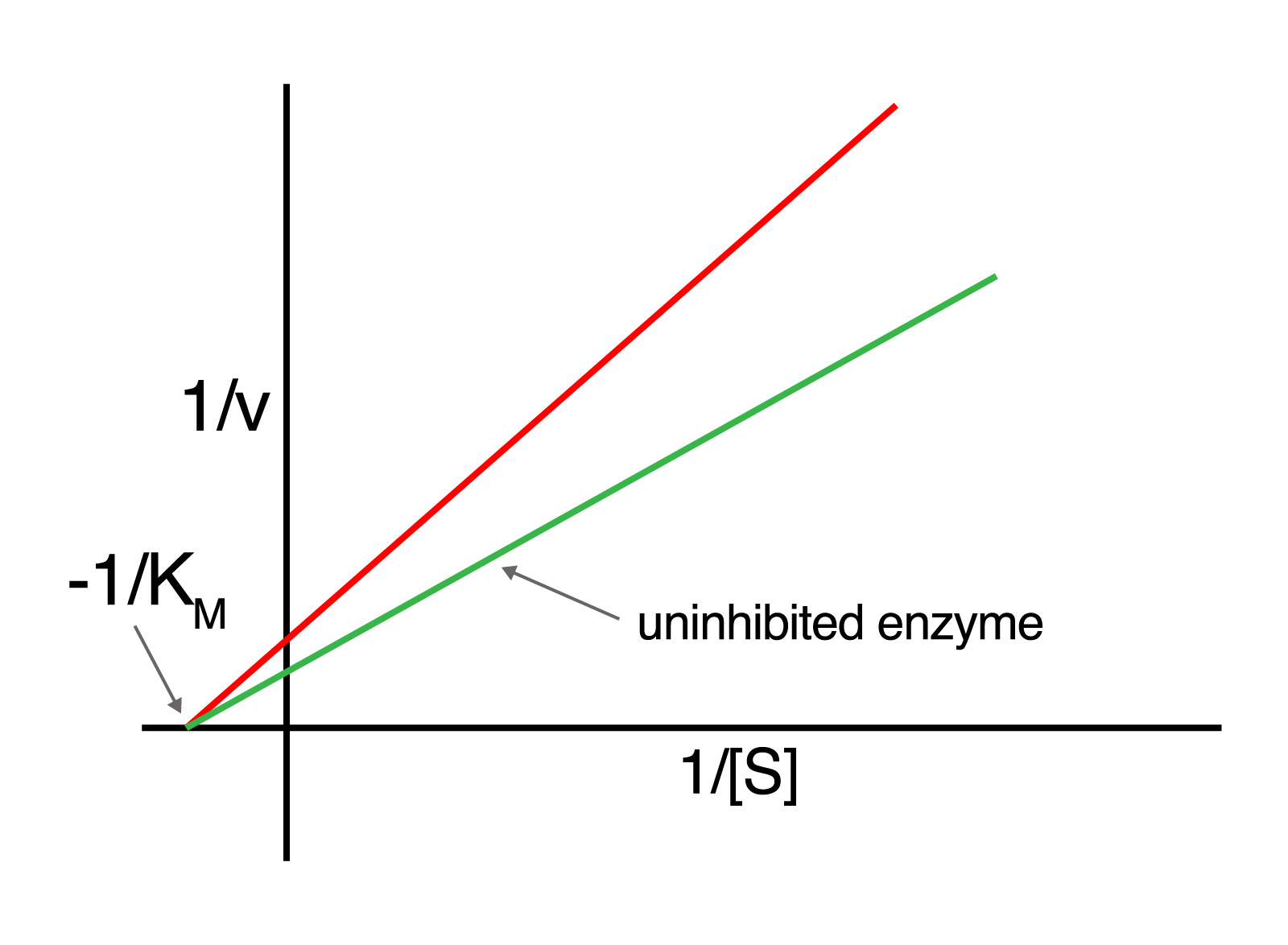 Based on the information provided in the plot, which of the following antiretroviral drugs did the physician most likely prescribe?